





Introduction
Third-Party Risk Management (TPRM) Strategy is a comforting lie we tell ourselves: “I have secured my perimeter.” You have the best firewalls, the most expensive EDR, and a 24/7 SOC. But in 2026, the perimeter is dead. Your data does not live in your building anymore. It lives in Salesforce, AWS, Slack, and a dozen other SaaS tools you don’t own. Worse, your code relies on libraries written by people you have never met.
The modern attack surface is not a castle; it is a supply chain. And right now, that chain is breaking. From the SolarWinds catastrophe of the past to the AI-driven supply chain injections of 2026, history teaches us one thing: You are only as secure as your weakest vendor.
Most organizations rely on a “Checklist Compliance” model—sending a generic Excel spreadsheet to a vendor once a year and hoping they tell the truth. This is not security; it is bureaucracy. To survive the threat landscape of 2026, we need a radical shift. We need aStrategy that is dynamic, continuous, and ruthless. This guide will not just tell you why you need to vet your vendors; it will provide a 3,000-word blueprint on how to build a Third-Party Risk Management (TPRM) Strategy that sees the invisible risks before they strike.
Part 1: The Death of the Questionnaire
For decades, the standard Third-Party Risk Management (TPRM) Strategy was the “Annual Security Questionnaire.” It was a static snapshot in time. You asked, “Do you encrypt data?” The vendor checked “Yes.” You filed the PDF and forgot about it for 365 days.
That model is now obsolete for three reasons:
- The Speed of Change: A vendor might be secure on Monday (when they sign your form) and breached on Tuesday (Zero-Day exploit). Your annual questionnaire misses the breach for 364 days.
- Subjective Honesty: innovative startups often “stretch the truth” on questionnaires to close deals. Without technical verification, you are relying on the honor system in a world of thieves.
- The “Fourth-Party” Blind Spot: You trust Vendor A. But Vendor A outsources their hosting to Vendor B, who hires contractors from Vendor C. Your questionnaire only looks one level deep.
A modern Third-Party Risk Management (TPRM) Strategy moves from “Point-in-Time” assessment to “Continuous Lifecycle” management. It assumes that every vendor is compromised until proven otherwise.
Part 2: The Fourth-Party Paradox (The Vendor’s Vendor)
The most dangerous threat in 2026 is not the vendor you know; it is the vendor they use. This is the “N-th Party” risk.
- The Scenario: You hire a top-tier HR software provider. They are SOC2 compliant. But they use a cheap, obscure plugin for PDF generation. That plugin gets hacked. The hackers ride the plugin into the HR software, and from there, into your network.
- The Solution: Your Third–Party Risk Management (TPRM) Strategy must mandate “Downstream Visibility.” You must contractually require your critical vendors to disclose their critical vendors.
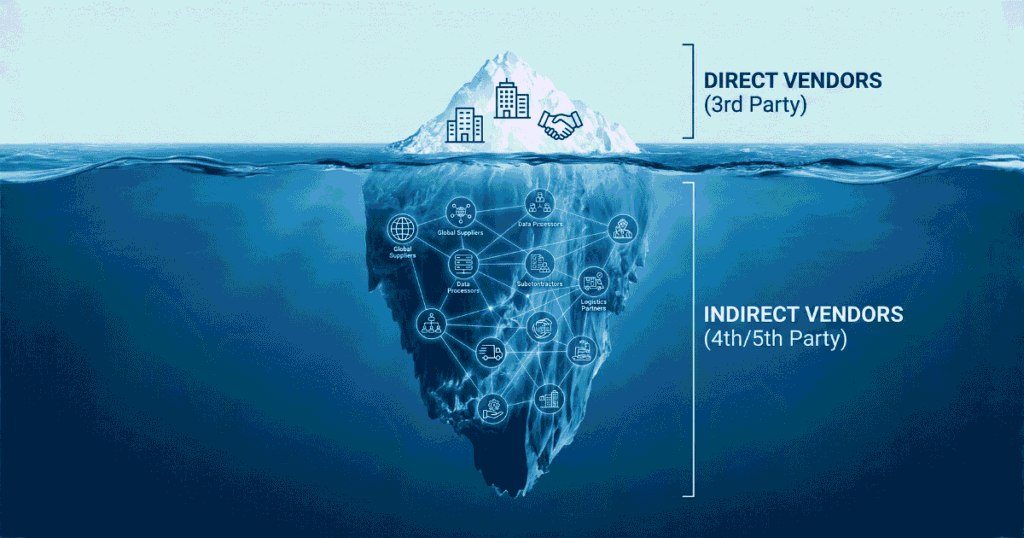
Visualizing the Chain
Imagine a tree root system. You are the trunk. Your direct vendors are the thick roots. But the tiny, unseen rootlets (4th and 5th parties) are often where the rot begins. If your Third-Party Risk Management (TPRM) Strategy does not map this root system, you are blind to 90% of your risk.
Part 3: The Technical Enforcer: SBOM (Software Bill of Materials)
In 2026, you cannot trust software just because it comes from a big brand. You need to know the ingredients. This is where the Software Bill of Materials (SBOM) becomes the cornerstone of your Third-Party Risk Management (TPRM) Strategy.
An SBOM is an ingredient list. It tells you exactly which open-source libraries (Log4j, OpenSSL, React) are inside the software you are buying.
- Why it matters: When a new vulnerability drops (like the next Log4j), you don’t have to email 50 vendors asking, “Are we affected?” You simply scan your SBOM repository.
- The Mandate: Your Third-Party Risk Management (TPRM) Strategy should enforce a “No SBOM, No Contract” policy for all software vendors.Once identified, you can apply the same rigor here as you do with your internal proactive patch management strategy.

Part 4: The Legal Shield (DORA, NIST, and GDPR)
A robust Third-Party Risk Management (TPRM) Strategy is not just about hackers; it is about regulators. 2026 has seen the full enforcement of the Digital Operational Resilience Act (DORA) in Europe, which has global ripples.
- DORA Mandates: Financial institutions must have an exit strategy for critical ICT providers. You cannot be “locked in” to a vendor.
- NIST SP 800-161: This is the gold standard for Supply Chain Risk Management (SCRM). It bridges the gap between cybersecurity and acquisition.
Your Third-Party Risk Management (TPRM) Strategy must explicitly reference these frameworks. If you are breached via a vendor, the first thing the auditors will ask is, “Did you follow NIST guidelines?” If the answer is no, the fines will be catastrophic.
Part 5: Continuous Monitoring Architecture
How do we replace the annual questionnaire? With data streams. A Third-Party Risk Management (TPRM) Strategy in 2026 relies on external risk scoring tools (like SecurityScorecard, BitSight, or UpGuard). These tools scan the public internet presence of your vendors 24/7.
- What they see: Open ports, expired SSL certificates, leaked credentials on the Dark Web, and email spoofing vulnerabilities (DMARC records).
- The Trigger: If a vendor’s score drops below a ‘B’, your Third-Party Risk Management (TPRM) Strategy should trigger an automatic alert to your GRC team to investigate.
Part 6: Tiering Your Vendors (The Triage)
You cannot monitor 500 vendors with the same intensity. You must categorize them.
- Tier 1 (Critical): They hold PII/PHI or have direct network access (e.g., MSPs, Cloud Providers).
- Action: Live penetration testing, on-site audits, continuous scoring.
- Tier 2 (High): They hold sensitive business data but no network access (e.g., SaaS Project Management).
- Action: Annual SOC2 review, SBOM analysis.
- Tier 3 (Low): No data access (e.g., Cafeteria vendor, Landscaping).
- Action: Basic financial viability check.
A Third-Party Risk Management (TPRM) Strategy that treats the cafeteria vendor the same as the cloud provider is a strategy destined to fail from alert fatigue.
Part 7: The “Kill Switch” (Incident Response)
What happens when a vendor is breached? Most companies panic. A proactive Third-Party Risk Management (TPRM) Strategy includes a “Vendor Incident Response Plan.”
- Communication Channels: Do you have the emergency cell phone number of the vendor’s CISO? (Support emails are useless in a crisis).
- The Disconnect Switch: Can you sever the API connection or VPN tunnel instantly?
- The “Right to Audit”: Does your contract allow you to send your forensics team to investigate their breach?
Part 8: The Offboarding Gap
The most dangerous vendor is the ex-vendor. Companies often fire a vendor but forget to revoke their access. The vendor still has a user account, an API key, or a physical badge.
- The Zombie Account: Hackers love ex-vendor accounts because no one is watching them.
- The Fix: Your Third-Party Risk Management (TPRM) Strategy must be tied to Accounts Payable. When the payments stop, the access stops. Automatically.
Part 9: Step-by-Step Implementation Guide
Building this beast takes time. Here is the 4-phase rollout for your Third-Party Risk Management (TPRM) Strategy.
Phase 1: Discovery (Months 1-2)
- Scrape your accounting software to find everyone you pay.
- Scan your firewall logs to see who you are sending data to.
- Build the Master Vendor Inventory.
Phase 2: Classification (Month 3)
- Apply the Tier 1/2/3 logic.
- Identify the “Crown Jewel” vendors.
Phase 3: Remediation (Months 4-6)
- Send out the new security addendums (requiring SBOMs and breach notification < 24 hours).
- Connect the Continuous Monitoring tools.
Phase 4: Optimization (Month 6+)
- Run Tabletop Exercises simulating a Tier 1 vendor failure.
- Refine the Third-Party Risk Management (TPRM) Strategy based on the results.
Conclusion: From Trust to Verification
The era of blind trust is over. In the interconnected economy of 2026, your neighbor’s fire is your fire. A Third-Party Risk Management (TPRM) Strategy is not just an IT problem; it is a business survival imperative. By shifting from static questionnaires to dynamic, data-driven monitoring, and by shining a light into the dark corners of the Fourth Party ecosystem, you can build a fortress that extends beyond your own walls.
The question is not if a vendor will fail you. It is when. And when they do, your Third-Party Risk Management (TPRM) Strategy will be the difference between a minor hiccup and a headline-making disaster.